
Market News
UAE trains 80,000 government workers as AI ‘super users’ as Ai Everything Abu Dhabi opens
Key Points
- The UAE is training around 80,000 government employees to become AI “super users” able to build agents, Minister of State for Artificial Intelligence Omar Sultan Al Olama told CNBC’s Dan Murphy on Tuesday.
- Ai Everything Abu Dhabi opened at ADNEC with more than 400 exhibitors, over 180 speakers and more than 200 investors managing $100 billion in assets.
- Abu Dhabi officials used the opening day to press the emirate’s goal of becoming the world’s first AI-native government by 2027.
- Mistral AI CEO Arthur Mensch said demand for alternatives to U.S. and Chinese AI suppliers is enormous, with about 55% of the global economy sitting outside both countries.
The United Arab Emirates is training around 80,000 government employees to become AI “super users,” the country’s minister for artificial intelligence said Tuesday, as Ai Everything Abu Dhabi opened with officials pitching the capital as a ready-made home for compute, capital and early adopters.
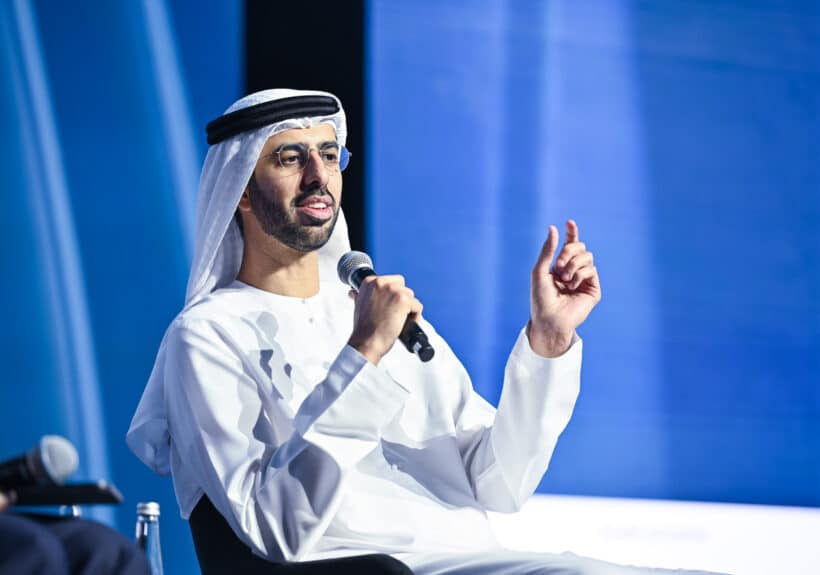
Omar Sultan Al Olama, UAE Minister of State for Artificial Intelligence, made the disclosure in conversation with CNBC’s Dan Murphy during a session titled “Building the Government of the Future: Data, Agentic AI and a Shifting Global Order.”
“Our playbook is simple: every single person to ride this wave needs to understand this technology, needs to be able to utilise it, and needs to be able to benefit from it,” Al Olama told Murphy. “We’ve gone on a very aggressive campaign to train around 80,000 government employees, to become super users of AI, being able to build agents and leverage these models.”
Advertisement
The two-day event, billed by organizers as the world’s largest AI-first expo and summit, drew more than 400 AI exhibitors, over 180 speakers and more than 200 investors managing $100 billion in assets to the ADNEC Centre. Visitors came from more than 70 countries.
The billion-dollar company of one
Al Olama predicted the rise of one-person companies powered by AI agents that could grow into multimillion or even billion-dollar businesses.
For a country the size of the UAE, he said, agents could “multiply their ability, scale and impact,” allowing it to compete economically with much larger markets.
Asked by Murphy how governments can balance innovation against regulation, the minister pointed to a structural problem he said most countries share.
“The challenge that most governments have is that the innovator sits in the innovator’s section and the regulator in the regulator’s section, with no cross-pollination of thought and planning,” Al Olama said. “In the UAE, many times we’ve had the innovator come into the regulator’s seat, and the regulator being asked by our leadership to think like an innovator. And that’s a secret sauce.”
During audience questions, he defined winning in AI by its social reach rather than its economic output. “Our definition of winning is that you change the largest number of lives of people positively by using artificial intelligence,” he said.
Advertisement
Al Olama argued the biggest gains will accrue where AI is deployed, not necessarily where it is invented. “We want to be the fastest to market. We want to be the country and the cities that deploy AI to improve quality of life in the most effective way possible,” he said.
Abu Dhabi’s AI-native target
Ahmed Tamim Hisham Al Kuttab, chairman of Abu Dhabi’s Department of Government Enablement, opened the summit with a keynote built around the emirate’s ambition to become the world’s first AI-native government by 2027.
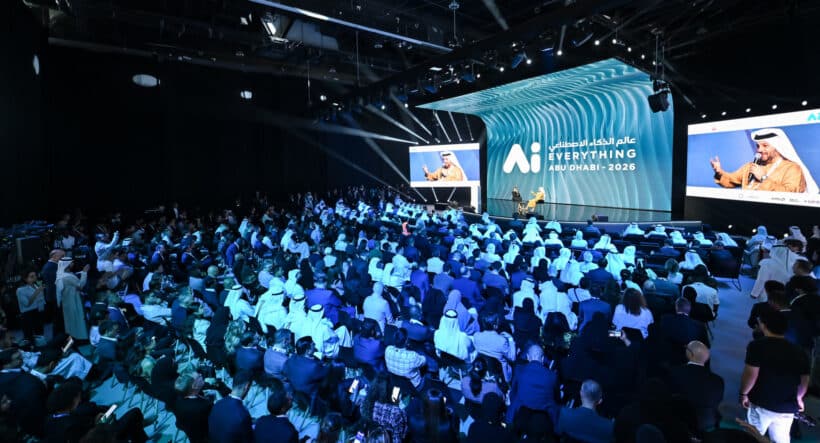
“Societies that start building the foundations today will pull ahead every year, and those that wait will find the gap harder to close. Abu Dhabi and the UAE did not wait,” Al Kuttab said. “Every entrepreneur and business in this room is looking for the same three things: compute, capital and customers willing to go first.”
Faisal Al Bannai, adviser to the UAE president and secretary general of the Advanced Technology Research Council, framed AI as a core state capability, arguing that nations owning their compute, models and talent will shape the century.
“In the UAE, we are adopting the best-in-class models while building our own sovereign capabilities and putting checks and measures in place,” Al Bannai said, adding that the country’s edge lies in deploying practical use cases quickly.
Mistral’s sovereignty pitch
Arthur Mensch, co-founder and CEO of French AI company Mistral AI, used his first Abu Dhabi summit appearance to address the trade-off at the center of national AI strategies: open models widen access but can make oversight harder.
Advertisement
“Sovereignty is also a global issue. Around 55% of the global economy sits outside the US and China. That creates enormous demand for alternative technology suppliers,” Mensch said.
He said portability is critical, letting companies reduce dependence on any single infrastructure provider, and that AI should be treated as a strategic commodity countries can produce, import and secure through partnerships.
An AI actress takes questions
One of the day’s most-watched sessions featured Tilly Norwood, billed as the world’s first AI-generated virtual actress, who appeared live on stage to discuss her upcoming feature debut in “Misaligned.”
Norwood greeted the crowd in Arabic and took unscripted questions from attendees in real time. “It’s been an absolute whirlwind of a year in filmmaking, and suddenly everyone wants a piece of the AI character pie,” she said.
Tom Davidson, chief creative officer of Particle6, the studio behind Norwood, compared the shift to animation. “You can create an entire film, identify a section that isn’t working and recreate just that part with AI, without having to reshoot everything,” he said.
On the show floor
Infrastructure dominated the exhibition hall. H3C showcased end-to-end AI infrastructure, with Hongtao Liu, general manager of H3C MENA, saying organizations in the region are moving “from AI experimentation to production-scale deployment.”
Seagate pitched its high-capacity Exos enterprise drives, citing its own research that 99% of organizations globally expect AI to increase their storage requirements over the next three years.
Regional players also pushed to commercialize. Sharjah Research Technology & Innovation Park’s SPARK AI Hub presented government service assistants and enterprise agents, while Khalifa University Enterprises Company launched new ventures spanning healthcare, government, industry and sustainability.