
Aboki News
Private Creditors Form Group to Negotiate Africa Debt Relief - BLOOMBERG
By Alonso Soto
- Creditors warn against blanket approach to relief on continent
- Group represents $9 trillion of assets under management
Private creditors representing more than $9 trillion of assets under management formed a group to negotiate debt relief for African nations, warning of the risks of a blanket approach to the process.
The so-called Africa Private Creditor Working Group will assist African countries and other debt providers to cushion the economic impact of the coronavirus pandemic on the continent, it said in a statement Friday. The group represents 25 asset managers and institutions that financed countries and corporates via Eurobond, syndicated loans and trade finance.
African countries are asking official and private creditors to temporarily suspend $44 billion in debt payments this year in order to channel scarce resources to contain the spread of the coronavirus. Some investors are concerned that countries could unilaterally halt payments, locking them out of debt markets and hurting creditors as well, said Lars Bane, director of Farallon Capital Europe LLP and a member of the group.
“There is a bit of concern in terms of a growing narrative pushing for this blanket standstill and even more concerning, debt forgiveness in Africa,” Bane said in a phone interview. “There is genuine consensus that you do have to have a case-by-case approach to have the best outcome for both the borrowers and lenders.”
The group’s members include Aberdeen Asset Management Plc, Amia Capital LLP, Ninety One U.K. Ltd., Pharo Management LLC and Greylock Capital Management LLC.
An understanding with investors that clarifies debtors’ positions on future payments could reduce sovereign-bond yields and help governments return to international capital markets soon. “Until this issue is clarified, none or very few African issuers will have market access in the near future,” Bane said.
Specter of Default
The pandemic has raised the specter of a slew of debt defaults in developing countries that had to shut down their economies to try and stop the spread of the virus. Demand for the raw materials many of the nations produce has plummeted.
For debt-relief advocacy group Jubilee Debt Campaign, private creditors will have to take losses as poor countries ramp up spending on health and social protection measures.
“Private creditors lent at high interest rates to poor countries because they claimed loans were high-risk,” said Tim Jones, head of policy at the campaign. “The risk has come home to roost and lenders need to accept they cannot make large profits from these loans.”
Diplomatic intrigues stall evacuation of Nigerians from Canada - THE GUARD
By Wole Oyebade, Bridget Chiedu Onochie and Joke Falaju, Abuja
• May Arrive Monday
• Evacuees From Thailand To Pay N162.3million For Hotel Accommodation, Feeding
• ‘Govt. Does Not Have Capacity To Foot The Bill’
Diplomatic intrigues and conflict of interest over the choice of operating carrier might explain why the scheduled evacuation of 200 Nigerians from Canada was stalled last Wednesday. While the Nigerian government-designated local carrier, Air Peace, for the special operation, the Canadian government preferred Ethiopian Airlines, though at more expensive fares for the travellers.
Meanwhile, Nigerian evacuees from Thailand are expected to pay about N162.3million for hotel accommodation and feeding. The Guardian learnt that each of the evacuees was expected to pay N240, 000 as hotel accommodation for the period of 16 days and N57, 600 for feeding for the same period, making a total of N297, 600.
The federal government, after the arrival of the evacuees at the Nnamdi Azikiwe International Airport in Abuja, had handed them over to the Nigeria Centre for Disease Control (NCDC) to properly quarantine for 14 days period to ensure they are COVID-19 free.
Although the government did not disclose where the evacuees were being quarantined, The Guardian learnt that the federal government had negotiated with some hotels in the Federal Capital Territory (FCT) to accommodate them, including Bolingo Hotel (300 rooms); Apo Apartments (61 rooms); Chida International Hotel (200 rooms); Belvior Hotel (30 rooms) and Barcelona Hotels (300 rooms).
The evacuees had been concerned about who was to pay their hotel bills, but a letter by the Nigerian Embassy in Bangkok, Thailand, dated May 14, this year and signed by the Head of Chancery, Nicholas Uhomoibi, read: “I am directed to bring to your attention that due to the measure that are beyond control of the COVID-19 local organising team in Nigeria, all evacuees going to Nigeria henceforth are to now pay for the quarantine, isolation, accommodation centre or hotel before departure and arrival in Nigeria.
“In this regard, all prospective evacuees are to take note of the negotiated rate- accommodation, N15, 000 for 16 days, equals N240, 000; feeding is N3, 600 multiplied by 16 days, making N57, 600, making a total of N297, 600.”
The letter urged the evacuees to be informed that the embassy had been instructed not to airlift any evacuees who did not pay the fees. The Ministry of Foreign Affairs, which confirmed the government position yesterday in Abuja, stated that the decision was due to its inability to foot the bill. “The explanation for that is that the government does not have the capacity to foot the bill,” stated a ministry source, who confirmed the amount.The ministry, however, said the government was still negotiating to see how the amount could be reduced, as it was seeking cheaper hotels for the prospective evacuees.
The Guardian yesterday reported that Air Peace was denied landing right permits; hence had to delay the evacuation exercise till Nigerian and Canadian governments resolved the grey areas. But sources from the Ministry of Foreign Affairs yesterday disclosed that the Canadian High Commission had opened talks with Ethiopian Airlines for the evacuation of Nigerians. Ethiopian Airlines (ET) has been airlifting Canadian citizens from different parts of Africa lately. The federal government, through the ministries of Aviation and Foreign Affairs, has, however, waded into the matter, insisting that the Nigerian carrier has to operate the flight, in tandem with its new position that all evacuation flights must be conducted by Nigerian carriers. It was learnt that ET is charging $2, 500 per voluntary returnee for the flight already planned for Monday, May 18, while Air Peace charged $1,134 for the same trip. To date, 319 passengers have paid to the Nigerian airline, which has concluded plans to operate full flight to the North American country.
Some of the Nigerians, who had booked and paid Air Peace for the flight, were already complaining about the insistence of the Canadian High Commission to choose a foreign airline over a Nigerian carrier.
Shocked by the decision of the Canadian High Commission, an official of the Nigerian carrier said Air Peace had successfully flown to 40 countries, including Canada, the United States (US) and the United Kingdom (UK), noting that it was the airline that evacuated Israeli citizens from Nigeria in March. 2
The official added: “We have done many international flights, including landing in Canada. We have made 19 flights to the US since 2014. We have flown to Tel-Aviv several times and in March, we evacuated over 200 Israelis from Nigeria back during this COVID-19 lockdown. We have scheduled flight operations to United Arab Emirates (UAE), UK, Ireland, China, Turkey, Germany, Iceland, Switzerland and other countries.
“We have IATA Operational Safety Audit (IOSA) certification and we are a member of IATA. We have also evacuated Nigerians from South Africa during the xenophobic attack of Africans there.”
Reacting to the incident, former director general of the Nigerian Civil Aviation Authority (NCAA), Benedict Adeyileka, described the action of the Canada High Commission as political, urging the federal government to stand firmly on its position that a Nigerian carrier should conduct the airlift.
“I am a nationalist to the core. Anything Nigerian is good enough as long as it is qualified to carry out the operation, and Air Peace has international operation experience.
“I insist that the Nigerian government should put its foot down on this. Nigerian carriers should not be stopped from conducting international operations,” he said
Buyers crash Nigeria’s multi-million dollars liquefied gas demand - NEW TELEGRAPH
BY Adejumo kabir
Buyers at the weekend deferred deliveries of multi- million dollars Liquefied Natural Gas (LNG) from Nigeria, one of Europe’s key LNG suppliers. This cause by crater in the coronavirus pandemic has seen demand for Nigeria’s cargoes in Europe crash, which has created a fleet of tankers carrying LNG that are now just floating storage, according to commodity tracking firm Kpler, cited by an online news portal, Bloomberg.
Over the past two months, Nigeria continued to send LNG cargoes to one of its main markets, Europe, but with many major European economies in lockdown, demand has plunged, and customers with options to defer have been postponing the offloading of the cargoes.
LNG prices at their lowest in years have forced traders to keep LNG on the tankers, waiting for demand to improve. But prices are not set to improve in the summer, according to Manas Satapathy, managing director for energy at Accenture. “The worst is yet to come, we will likely see super low prices in late June, July, August,” Satapathy told Bloomberg.
The crash in LNG demand in Europe during the pandemic and the high storage levels will likely mean that the continent will struggle to act as a sponge to absorb excess LNG supply this year as it did in 2019, Rystad Energy said in an analysis last week. Last year, Europe became the “de facto global LNG sink,” when milder winter in Northeast Asia slowed down LNG demand growth there, the energy research firm said.
In 2019, Europe’s total LNG imports surged by 80 per cent compared to 2018, while in January and February 2020 – before the European lockdowns and when the coronavirus hit Asia – Europe’s LNG imports jumped 35 per cent, thanks to the UK, Spain, and Belgium.
“We still don’t have an end date for when Europe will completely re-emerge from lockdown, and the impact will probably be deeper coming into the summer months. “With gas storage tanks already almost filled to the brim, Europe’s capacity to import and actually use the same amount of LNG as in 2019 seems like a tall order, especially if we see another mild winter,” Rystad Energy said.
Africa’s largest economy braces for big hit as oil prices plummet - CNBC
KEY POINTS
- The International Monetary Fund (IMF) on Thursday said it will be working closely with the Nigerian authorities in the coming days to assess any vulnerabilities which may be exposed by the sharp decline in crude prices.
- Nigerian dollar bonds sank to record lows stocks on Thursday hit a new four-year low, as fears grow over the devaluation of the naira currency.
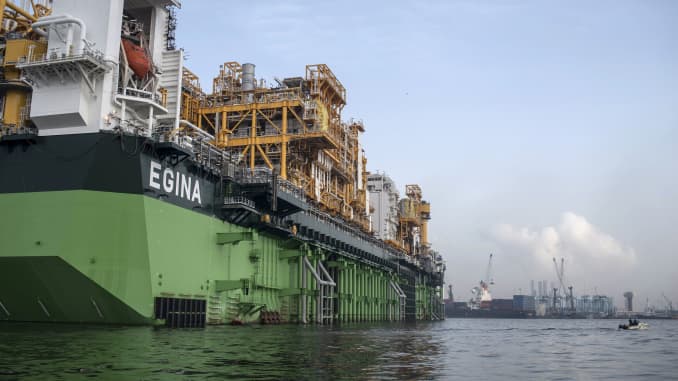 The Egina floating production storage and offloading vessel, the largest of its kind in Nigeria, is berthed in Lagos harbor on February 23, 2017.
Stefan Heunis | AFP | Getty Images
The Egina floating production storage and offloading vessel, the largest of its kind in Nigeria, is berthed in Lagos harbor on February 23, 2017.
Stefan Heunis | AFP | Getty Images
With oil prices plunging amid concerns over a price war between Russia and Saudi Arabia, and the coronavirus outbreak obliterating stock markets, Africa’s largest economy is in a precarious position.
The International Monetary Fund (IMF) on Thursday said it will be working closely with the Nigerian authorities in the coming days to assess any vulnerabilities which may be exposed by the sharp decline in crude prices, as Nigerian and Angolan dollar bonds sank to record lows.
Nigerian stocks on Thursday headed for their fifth straight day of losses to a new four-year low, and a fall in oil prices to just over $30 per barrel, rising external debt and a depreciating currency pose a threat to economic stability in the country of more than 190 million people. Nigeria is Africa’s largest economy in terms of GDP (gross domestic product).
While markedly lower oil prices will undoubtedly have broad adverse consequences for the Nigerian economy, the country is not quite as dependent on oil exports as the likes of Angola, which analysts expect to suffer a substantial blow this year.
Currency concerns
However, a prime concern for economists is Nigeria’s managed naira exchange rate, since even prior to the fallout from OPEC’s failure to reach an agreement with Russia on oil production cuts, the country’s foreign exchange reserves were in steady decline.
After the official exchange rate was devalued in 2016, foreign exchange reserves were approaching $25 billion, and the move failed to stop the slide of the parallel market exchange rate, which meant the Central Bank of Nigeria (CBN) was forced to act again the following year when the Nafex (Nigerian Autonomous Foreign Exchange Rate) was implemented. Reserves held just below $30 billion during this period.
“Extrapolating the trajectory observed thus far this year (the foreign exchange buffer shrunk by $2.3 billion during the first two months of 2020) suggests reserves could fall below the $30 billion mark by Q3 (the third quarter) and end the year just above $25 billion,” NKC African Economics Chief West Africa Economist Cobus de Hart said in a note earlier this week.
Oil dependent countries facing fiscal and social strain, IEA’s Birol says
Capital Economics Senior Emerging Markets Economist John Ashbourne on Wednesday echoed this projection, suggesting that reserves will soon fall below the $30 billion mark, which Nigerian policymakers had identified as a key benchmark.
Ashbourne predicted that the naira will end the year down 8% to 400 NGN against the U.S. dollar. He added that in Nigeria’s case, a weaker currency will not provide a boost to competitiveness, since the country does not have significant non-oil exports or the “domestic manufacturing base needed to substitute for imported goods.”
Reuters reported Thursday afternoon that the naira was being quoted at 370 to the dollar on the over-the-counter spot market.
‘Severe adverse consequences’
Parliament recently green lighted President Muhammadu Buhari’s request for $22.7 billion in foreign borrowing, but while external debt accumulation would usually be expected to support reserves, de Hart suggested that the sharp fall in global oil prices could potentially “more than offset” the boost.
“Firstly, should Brent crude oil prices average roughly $40pb (per barrel) for the remainder of the year, it would reduce Nigeria’s goods export receipts by roughly $14 billion (as opposed to our February baseline for oil prices to average $62.4 billion in 2020) — this may also be a conservative estimate, as it does not take into account any adverse impact on non-oil exports,” he said in the note Monday.
What’s more, Nigeria may have difficulty accumulating external debt following the fall in oil prices and its impact on the macroeconomic outlook, while the jittery investment environment raises the risk of a capital flight, de Hart highlighted.
 Bloomberg | Getty Images
Having previously backed the authorities to ride out the storm and maintain its foreign exchange rate at current levels in the immediate future, NKC analysts now believe that the naira’s prospects have “deteriorated markedly” and remains set for a “sharp fall” this year if current conditions persist.
The CBN will again be faced with the choice of whether to let the Nafex buckle or continue to artificially prop it up.
“We believe the CBN will continue to provide support in the near term, with a more drastic adjustment more likely in Q3,” de Hart projected.
“If the Nafex is not permitted to buckle, then the black-market rate should, and this might hold more severe adverse consequences for an economy that is now facing a gloomier outlook on multiple fronts.”
Can Palm Oil Demand Be Met Without Ruining Rainforests? - BLOOMBERG
By Anuradha Raghu
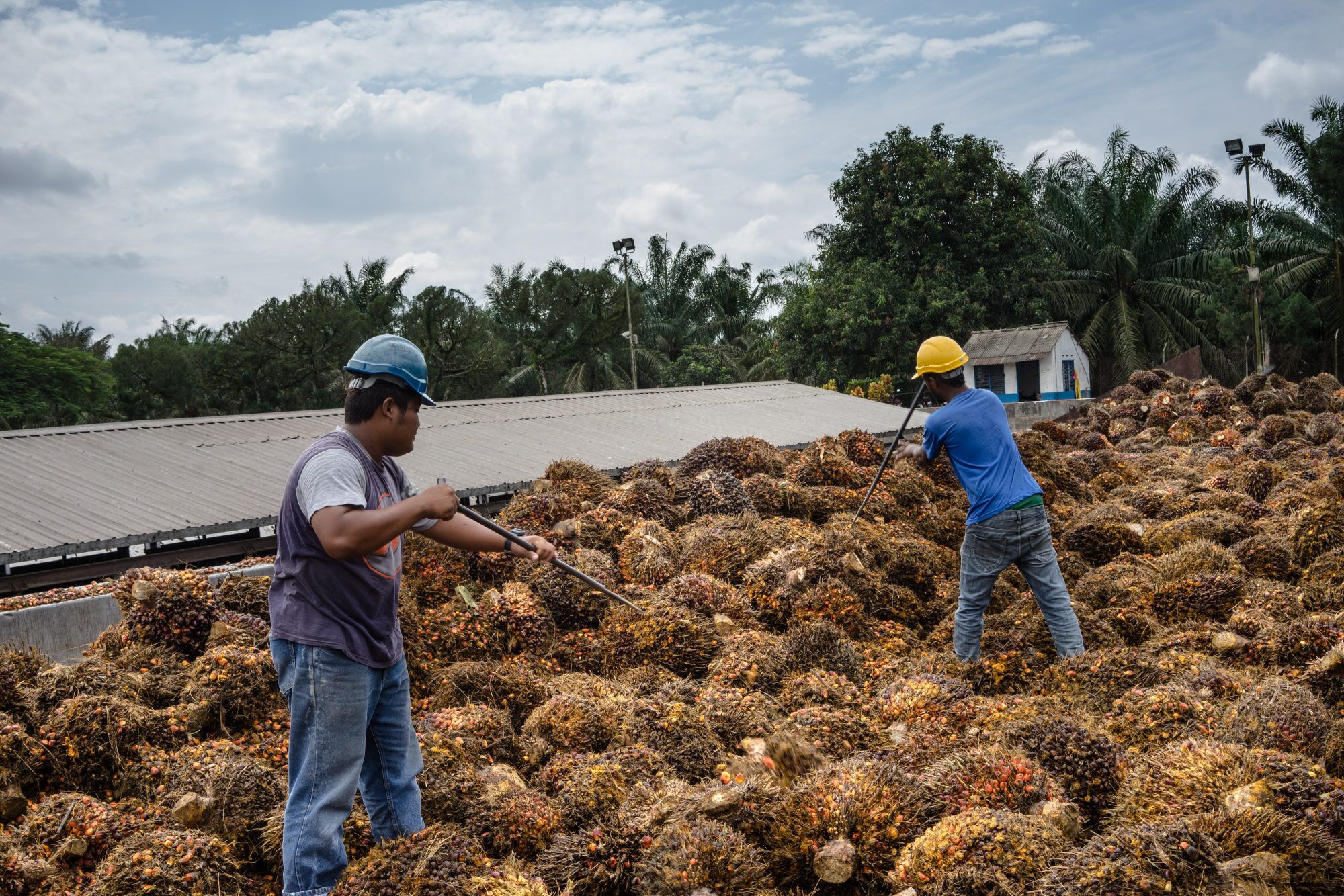
Workers sort bunches of palm fruit at a palm oil mill in Malaysia. Photographer: Sanjit Das/Bloomberg
Palm oil is one of the world’s most widely used and controversial commodities. Cheap, efficient and extraordinarily versatile, it’s found in thousands of everyday products, from cookies to shampoo to fuel. Yet surging cultivation of oil palm trees is linked to burning of tropical rainforests and the destruction of wildlife habitats in Southeast Asia. Environmental concerns have spurred the introduction of so-called sustainable palm oil, but its credibility has been questioned and it’s not clear yet whether there’s adequate market demand for the “greener” version.
1. Why is palm oil so controversial?
The use of palm oil in food products has doubled worldwide in the past 15 years. About half of all items in a supermarket are now likely to contain it, and global consumption could climb to more than 100 million tons per year by 2025, 50% more than in 2016, according to researcher Gro Intelligence. To meet the demand, critics say, some growers in Indonesia and Malaysia, which together account for 85% of global production, use “slash-and-burn” land clearance techniques that routinely blanket parts of Southeast Asia with stinging smoke. In 2015, forest fires in Indonesia alone pumped out more greenhouse gases per day than all sources in the U.S. The fires not only spew carbon dioxide into the atmosphere but also destroy significant carbon-absorbing forests and ground cover.
Indonesia’s Reach
Fires in Sumatra and Borneo have sent smoke to neighbors
2. What’s being done about it?
In an effort to reduce demand for palm oil, the European Union is restricting the types of biofuels made from palm oil that can be counted toward the bloc’s renewable-energy goals and aims to phase out palm oil-based biofuel entirely by 2030. Indonesia and Malaysia have called the act discriminatory and vowed to challenge it at the World Trade Organization. Another approach is to promote environmentally-sound palm oil cultivation. That’s the purpose of the Roundtable on Sustainable Palm Oil, an alliance of buyers and sellers formalized in 2004 that promulgates standards for “certified sustainable” palm oil products. Among its rules: Primary forests cannot be cleared to make room for new palm plantations and growers must abide by fair labor practices. The organization’s 4,000 members include farmers, traders, processors, manufacturers, retailers, investors, and environmental and social groups.
3. How is the push for sustainability going?
Currently, about one-fifth of global palm oil is compliant with the Roundtable’s sustainability standards. However, the value of the label is somewhat disputed. In early November, Greenpeace called eco-friendly palm oil “a con” because some Roundtable members are still cutting down forests. More than a dozen environmental advocacy organizations also endorsed a new report concluding that violations of the agreed-upon standards by Roundtable members are “systematic and widespread.” The Roundtable refuted many of the report’s findings, saying that the organization is still the best global system “to tackle the issues in the areas of the world when oil palm is grown.” A year and a half earlier, an academic study that used data from Indonesian Borneo had found no significant difference between certified and non-certified oil palm plantations on measures of sustainability.
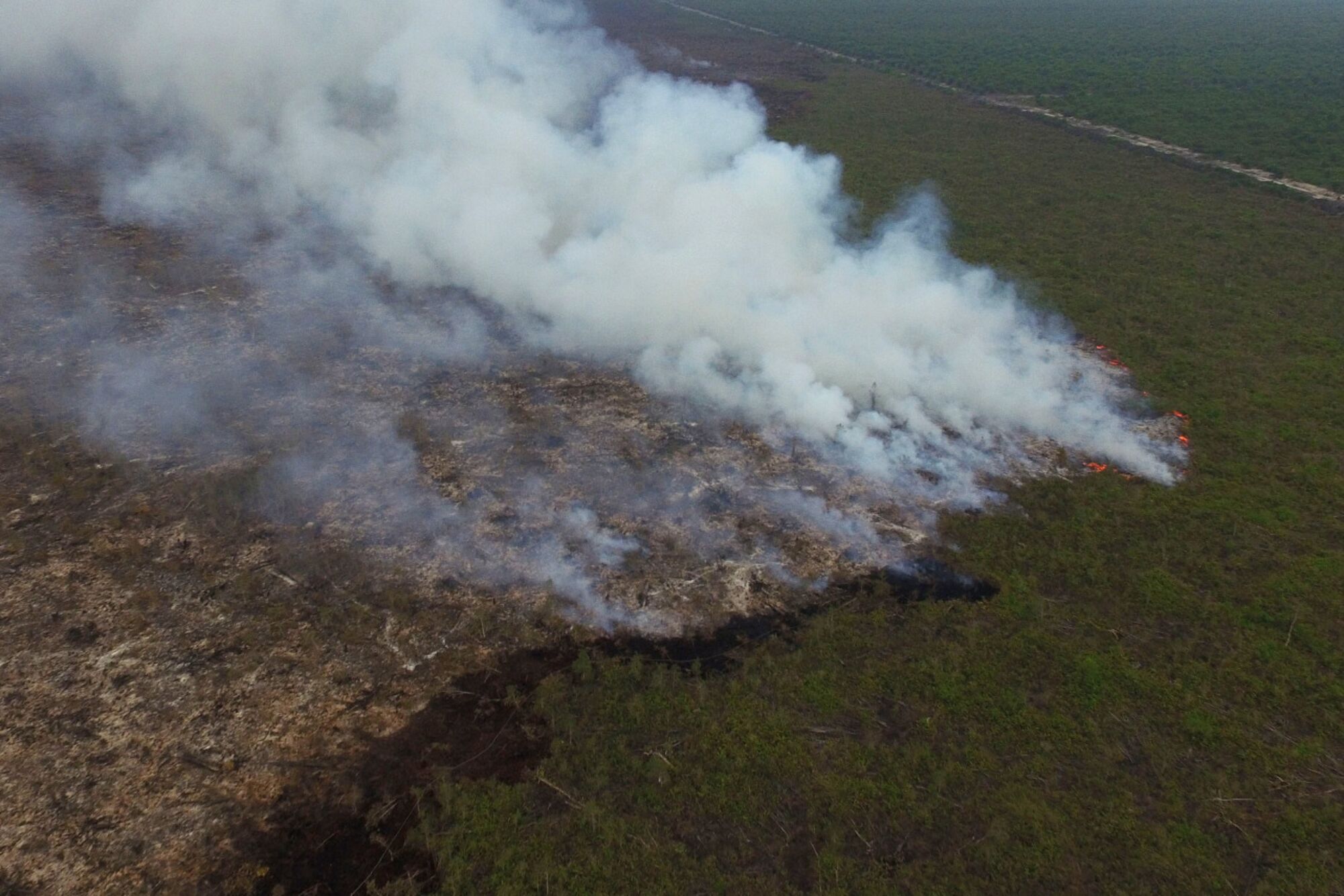
Smoke rises from a forest fire in South Sumatra, Indonesia in 2015.
Photographer: Dimas Ardian/Bloomberg
4. Does sustainable palm oil have a future?
Beyond the credibility issues, there are challenges to expanding the market. Part of the problem lies in the industry’s complex supply chain, with output from enormous plantations and hundreds of thousands of small farmers -- many too poor to bear the cost of compliance audits -- ending up in products made all over the world. Tracking oil from the field to the grocer’s shelf requires significant monitoring and added costs to prevent, for instance, the mixing of sustainably-grown oil with product that doesn’t meet the standard. Certified oil sells on average for about 5% more than the regular kind. Producers report that they’re only able to sell about half their certified oil as such because buyers balk at the premium; sellers dump the rest as conventional oil and forfeit the price difference. The Roundtable in November rolled out a program to spur the market by encouraging members who buy palm oil to increase their purchases year over year.
5. What’s being done to help small producers?
One challenge that has plagued the Roundtable is how to draw in small growers, known as smallholders. The rules to meet sustainability requirements can threaten the viability of these farmers, who make up about 40% of production in both Indonesia and Malaysia. To ease their burden and encourage compliance, the Roundtable in November introduced a new, separate standard for smallholders that allows them to meet sustainability regulations in phases and provides training and support along the way.
6. Why is palm oil so popular?
Oil pressed from the fleshy fruit that grows near the trunks of oil palm trees has a neutral taste, long shelf life and high smoking temperature. It’s used mainly for edible purposes such as cooking and confectionery-making, as well as for biofuel and animal feed. Oil pressed separately from the kernels inside the fruit is more saturated -- and thus semi-solid at room temperature -- and is used to make soaps, cosmetics and detergents. Oil palms can grow on a variety of soil, are resilient to short spells of drought or floods, and bear fruit year-round for decades. Palm oil also has a much higher yield per acre than alternatives -- up to ten times more than rapeseed, soybean, olive and sunflower oils. Its cultivation uses only about 7% of the world’s farming land but accounts for about 40% of total vegetable oil production, according to Oil World. That means that if palm oil were replaced with alternatives, more land would be needed to produce similar volumes.
The Reference Shelf
- The World Wildlife Fund’s report on palm oil.
- The Roundtable on Sustainable Palm Oil certification process.
- Green Palm Sustainability report on certified palm oil.
- Reports from Greenpeace and the Environmental Investigation Agency on palm oil.
- The Guardian identifies 10 things you need to know about sustainable palm oil.
- A Bloomberg QuickTake on Indonesian forest fires.
- The European Union’s delegated act on palm oil.