MARKET NEWS
Foreign Investors Shun Nigeria’s World-Beating Equities - BLOOMBERG
By Ray Ndlovu
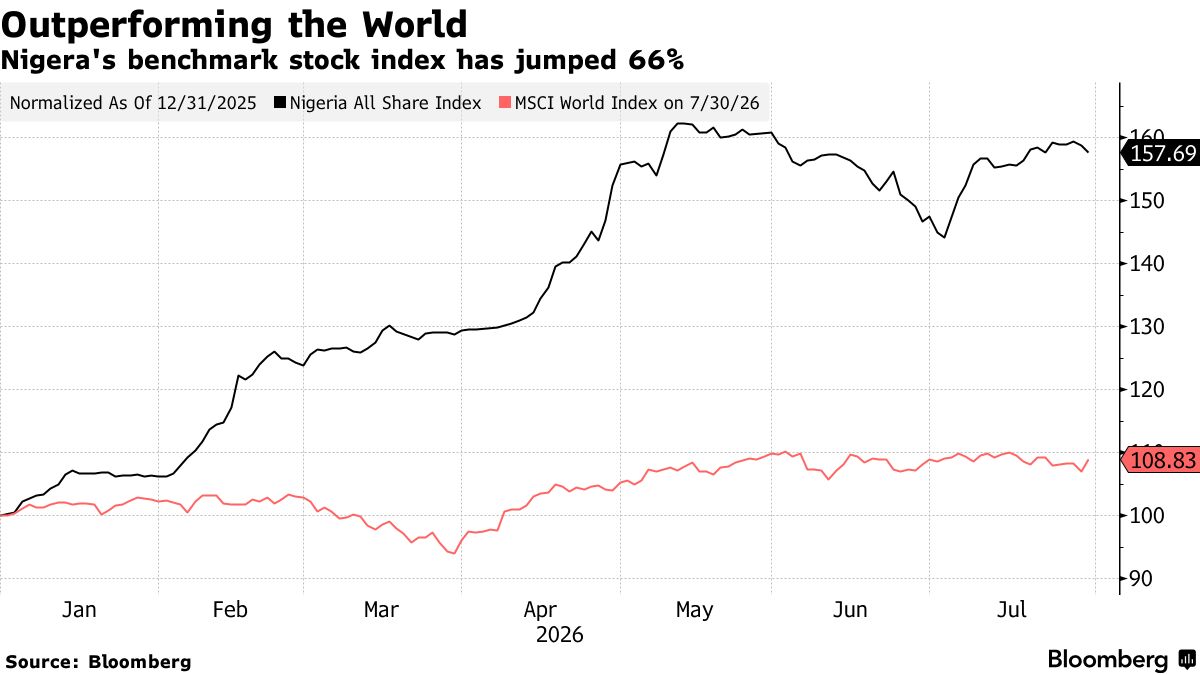
- Foreign investors shunned Nigerian stocks this year, choosing to focus on fixed-income assets, missing out on a 66% rally that made the market the world’s best performer.
- Non-residents accounted for 12% of all transactions in the first half of this year, down from 27% over the same period in 2025, while local investor participation increased to 88% from 73%.
- Domestic investors have been the biggest winners, piling into local stocks after a 63% rally last year, helped by the naira's stability, which has remained broadly stable this year.
Foreign investors shunned Nigerian stocks this year, choosing to focus on fixed-income assets, missing out on a 66% rally that made the market the world’s best performer.
Non-residents accounted for 12% of all transactions in the first half of this year, down from 27% over the same period in 2025, data provided by the Nigerian Exchange Group shows. By contrast, local investor participation increased to 88% from 73%.
Foreign investors instead favored Nigeria’s short-term debt, where average yields of about 20% offered a relatively risk-free return.
Equities became less attractive partly because Nigeria announced in March that it would adopt a T+1 settlement cycle from June, compelling overseas investors to prefund trades, while FTSE Russell also suspended
plans to reclassify the market, according to Arnold Dublin-Green, chief investment officer at BGL Asset Management.The central bank frequently sells the bills to attract dollar inflows to support foreign-exchange reserves and manage liquidity in the banking system.
Domestic investors have been the biggest winners, piling into local stocks after a 63% rally last year. The naira, which strengthened in 2025 for the first time in 13 years, has remained broadly stable this year, helping sustain demand for equities, said Damilola Okeleye, an equity trader at StoneX Financial Nigeria Ltd.
Naira’s stability has become hard to ignore as global investors rotate out of the artificial intelligence stocks in Asia. An AI frenzy in South Korea and Taiwan is under fresh investor scrutiny as they increasingly question long-term sustainability and seek to diversify portfolios.
South Korea’s Kospi Index, a bellwether of the AI trade, is down 22% so far this month.